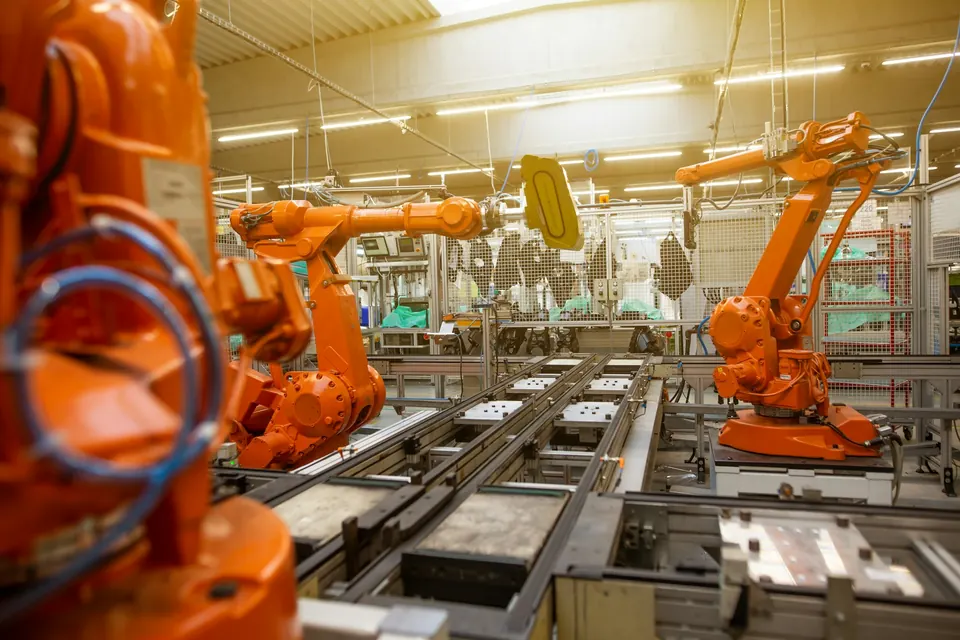
- Complete system
Connected Factory
From a proper asset registry to connected, measurable production, in stages that stick.

Specialised solution · Smart Manufacturing
PLC / SCADA / Modbus / OPC-UA integration. Live availability, performance, and quality — per line, per shift — so unplanned downtime and slow cycles are visible while the shift can still do something about them.
For mid-sized plants that already have machines, and often PLCs, but still lack a live OEE number for the shift. Start here, or grow into a Connected Factory later.
PLC and SCADA data lives on the plant floor and dies there.
Downtime happens — root cause is a guess, not a record.
OEE, if it exists, is compiled after the week is over, not managed during the shift.
Maintenance is reactive; the people who could have intervened never saw the drift.
CH 01
Integrate the signals you already have — PLC, SCADA, Modbus, and OPC-UA — instead of starting with a rip-and-replace.
CH 02
Publish live OEE, built from availability, performance, and quality, per line and per shift.
CH 03
Code stops and slow cycles so the next review is a record, not a debate.
CH 04
Raise alerts the operations and maintenance teams can act on, in the same operations layer.
CH 05
Feed work orders, and later ERP write-back, when you are ready to close the loop.
Most factories are not short of data. They are short of a path from the cabinet to the shift meeting.
01 · SENSE
Use existing PLC and SCADA points for run state, counts, and faults. Where a critical legacy machine has no usable signal, add retrofit sensing — non-invasive vibration, temperature, current, or acoustic sensors.
02 · SEND
Industrial gateways and standard protocols (Modbus, OPC-UA, and related plant interfaces) move the data off the floor. The historian can stay; it should no longer be the only place the truth lives.
03 · COMPUTE
IoT Pulse turns the feed into live dashboards: OEE and its three components, per line and per shift, plus condition trends on the assets that stop the plant.
04 · DECIDE AND ACT
Thresholds and trends raise alarms. Digital work orders give technicians a mobile record, photo evidence, and downtime coding. When the baseline is honest, predictive and closed-loop models can open a work order from a vibration or power signature and write back to the ERP.
One team designs, installs, and supports that loop — so the plant is not left to stitch a dashboard vendor to a sensor vendor and hope the number is trusted.
Typical results for comparable deployments, not a guarantee. Actual figures depend on site conditions.
These are estimates from comparable deployments, not a named-plant promise. Real movement depends on which lines you connect, how downtime is coded today, and whether alerts are allowed to change the day's work.
Technology
The devices and software we build this solution on.
From a proper asset registry to connected, measurable production, in stages that stick.
It means that on comparable deployments, OEE typically rises by about 8 points. It is not a guarantee and not a result attached to a named customer. Actual figures depend on site conditions.
Yes. This solution is built around integration — PLC, SCADA, Modbus, and OPC-UA — so you can use the signals you already have. Retrofit sensing is added only where a critical machine has no usable signal.
You need an honest current state. If nobody can produce a current asset list, start with asset registry and tagging. If the list is good enough and the data is already on the PLCs, you can begin with OEE on the lines that cost you the most.
No. The point is live OEE plus a path to action: alerts, downtime coding, and work orders, with one team accountable for the system. A dashboard that nobody acts on does not lift OEE.
Those are estimates, not a promise. Tell us about the site and we will apply typical results to your own figures. An engineer replies with a suggested setup within 24 hours.