
- Complete system
Connected Farm
Soil, weather, irrigation, livestock and cold chain connected for commercial growers.

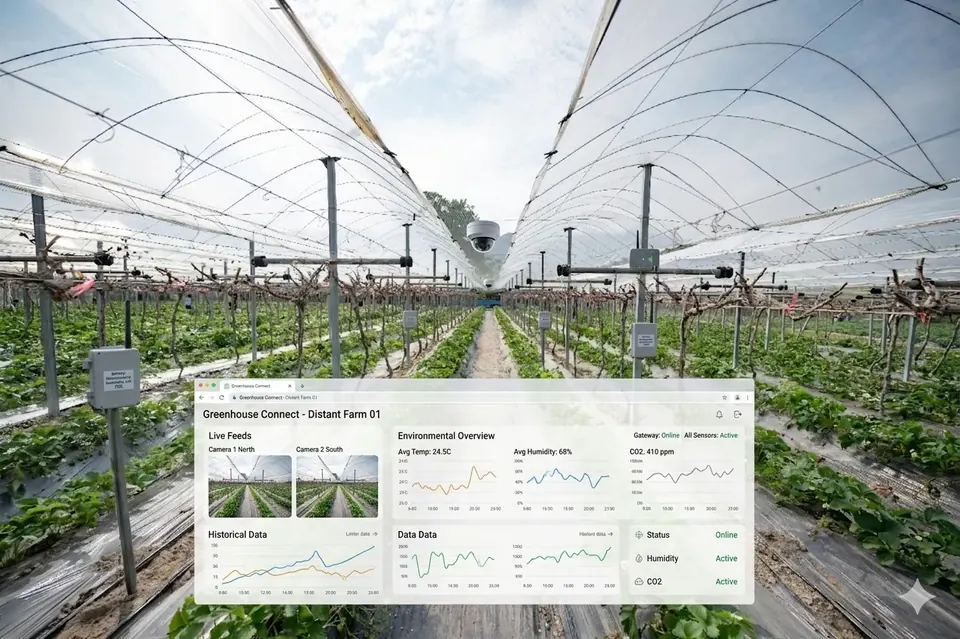
Specialised solution · Smart Farming
Water only when, where, and how much you actually need. Connect existing pumps, valves, and pivots to soil and weather data, and let the system do the math.
For growers and greenhouse teams still on a fixed timer. That costs water, energy, and crop health. Start here, or grow into a Connected Farm or Smart Greenhouse later.
Irrigation waste — watering when the soil doesn't need it
Fixed timers that ignore rain, humidity, and crop stage
Pumps, valves, and pivots that cannot be seen or overridden remotely
No water-use record when compliance, audits, or a seasonal review come due
The system does the scheduling math against live soil and weather, then controls the equipment you already have — with a manual override always available.
CH 01
Soil-trigger and schedule-based irrigation
CH 02
Pump and valve control with manual override
CH 03
Flow and pressure monitoring per block
CH 04
Water-use reports for compliance and audits
01 · SENSE
Soil moisture and related field signals, plus on-farm or in-house micro-climate and weather, tell you what the crop is actually feeling. Flow and pressure on the block confirm that the water that was commanded is the water that arrived.
02 · SEND
Field I/O connects existing pumps, valves, and pivots. Reflex I/O is the factory pre-wired 4G remote I/O we use on harsh sites: mount it, connect the sensors and actuators, and monitor in minutes.
03 · COMPUTE AND DECIDE
IoT Pulse is the operations layer. For greenhouses, FarmPulse — the farming vertical on IoT Pulse — adds soil-driven irrigation, crop profiles, and water-savings reporting measured against a fixed-timer baseline. Night-irrigation can be blocked when humidity is already driving disease risk.
04 · ACT
The system waters when the soil and the crop need it, not when the timer says so. Operators can override from the console, and they get a water-use report they can stand behind.
On comparable deployments, irrigation driven by soil and weather data uses 20–40% less water than fixed timers. FarmPulse also publishes a typical figure of at least 20% water reduction versus fixed timers on greenhouse deployments. Both are typical results, not a guarantee. Actual figures depend on crop, climate, and how the baseline was run.
Typical results for comparable deployments, not a guarantee. Actual figures depend on site conditions.
Technology
The devices and software we build this solution on.
FIELD PROOF
Our first custom field installation: two specialised control nodes across a cluster of roughly 40 greenhouses in Melaka — microclimate intelligence plus precise fertigation monitoring, with soil moisture to support irrigation timing.
Read the case studySoil, weather, irrigation, livestock and cold chain connected for commercial growers.
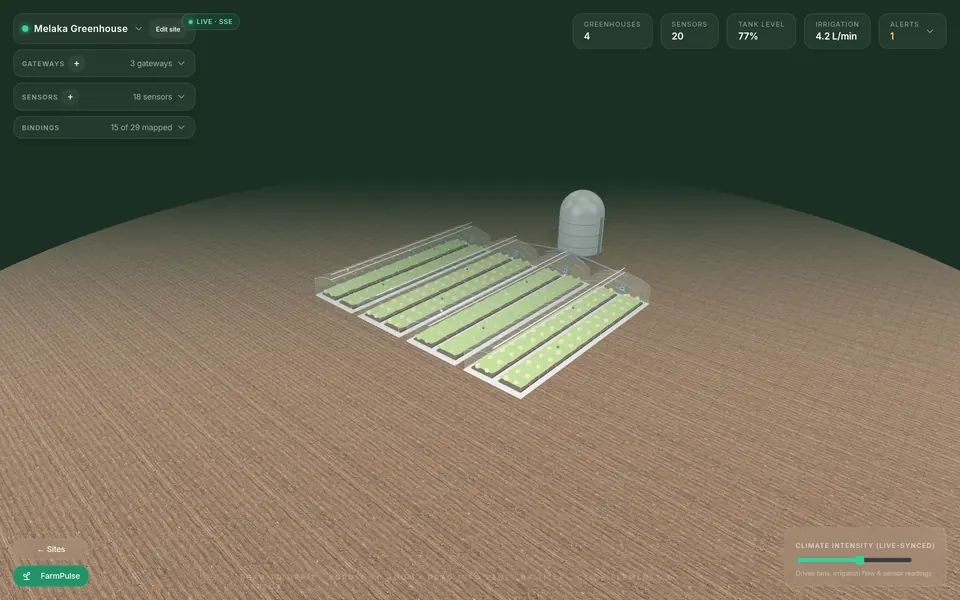
Greenhouse irrigation, disease-risk alerts and water-savings reporting.
On comparable deployments, irrigation driven by soil and weather data typically uses 20–40% less water than fixed timers. That is an estimate, not a promise. Actual savings depend on the crop, the climate, the equipment, and the timer schedule you are replacing.
That is the design intent: connect existing equipment to soil and weather data, and keep a manual override. During discovery we confirm what can be controlled as-is and where field I/O, such as Reflex I/O, is needed.
FarmPulse is the farming vertical on IoT Pulse, built first for greenhouses — soil-driven irrigation, disease-risk alerts, and savings reporting. This smart irrigation solution also covers commercial farm blocks that run pumps, valves, and pivots. We will recommend the surface that fits the site.
No. Many sites start with sensing and water-use visibility on a pilot block, then close the control loop once the team trusts the readings. On greenhouse work, FarmPulse publishes a typical pilot window of 6–8 weeks. That is a planning figure, not a guarantee.
Tell us about the site, the crop, and how you irrigate today. An engineer replies with a suggested setup within 24 hours.